

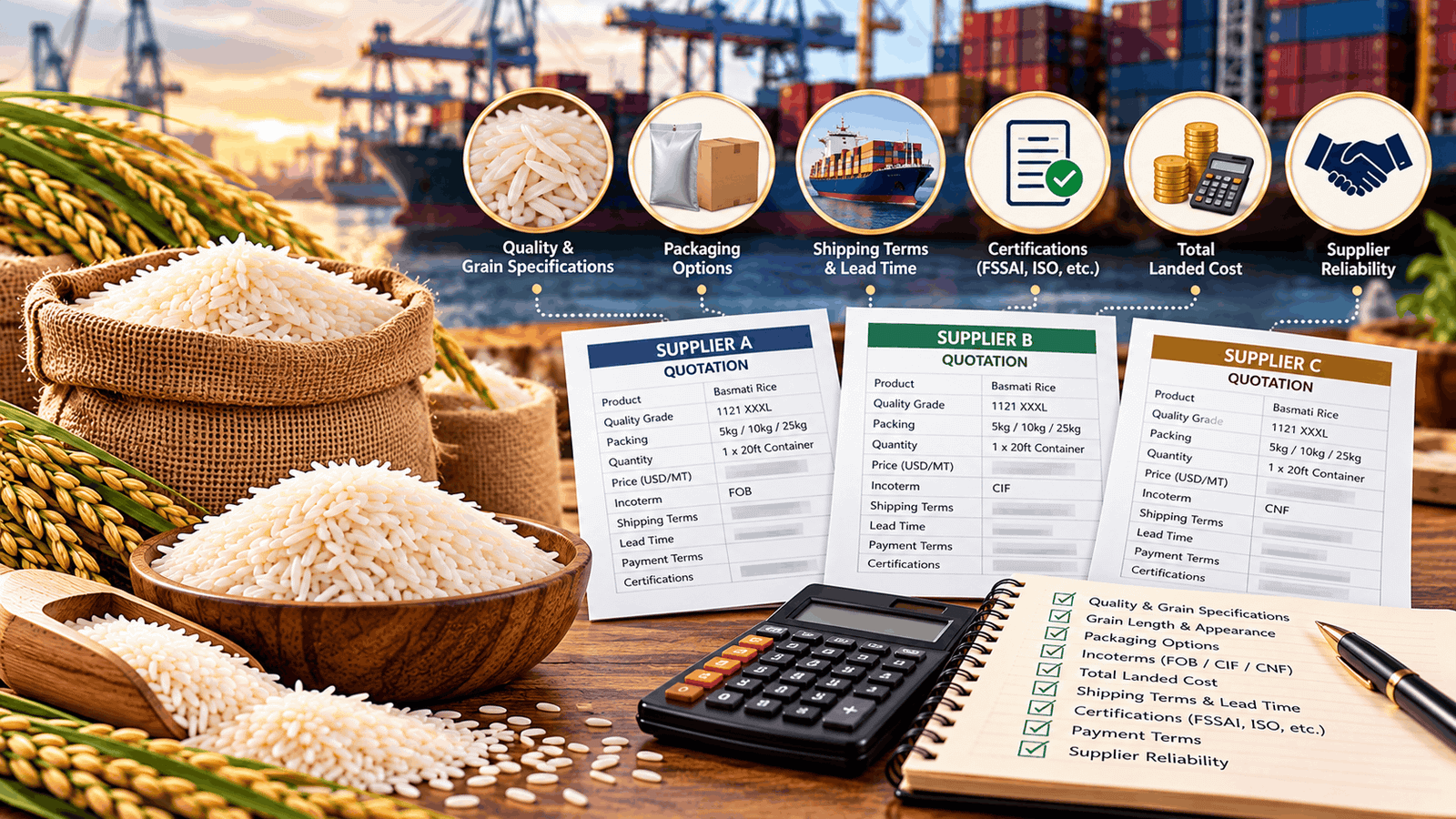
The lowest quote rarely delivers the lowest cost. A cheap Basmati offer can arrive with high broken content, failed residue tests, weak packaging, or a missed shipment window, and each one costs your business money.
For importers, distributors, retailers, and private-label brands, Basmati rice export quotations need a full side-by-side review. Price matters. It just isn’t the whole story.
The short answer: compare every quotation on six points. Grain specification, compliance, pesticide residue standards, packaging, Incoterms, and the supplier’s supply record. Price only makes sense once these matches.
This guide breaks down each factor, explains the technical terms, and gives you a practical table for comparing offers.
Why Price-Only Comparisons Fail in Basmati Rice Export
Two quotes can both say “1121 Basmati” and describe very different rice. One may be aged, sortexed, and low in broken grains. The other may be new crop with mixed varieties.
Same label. Different product.
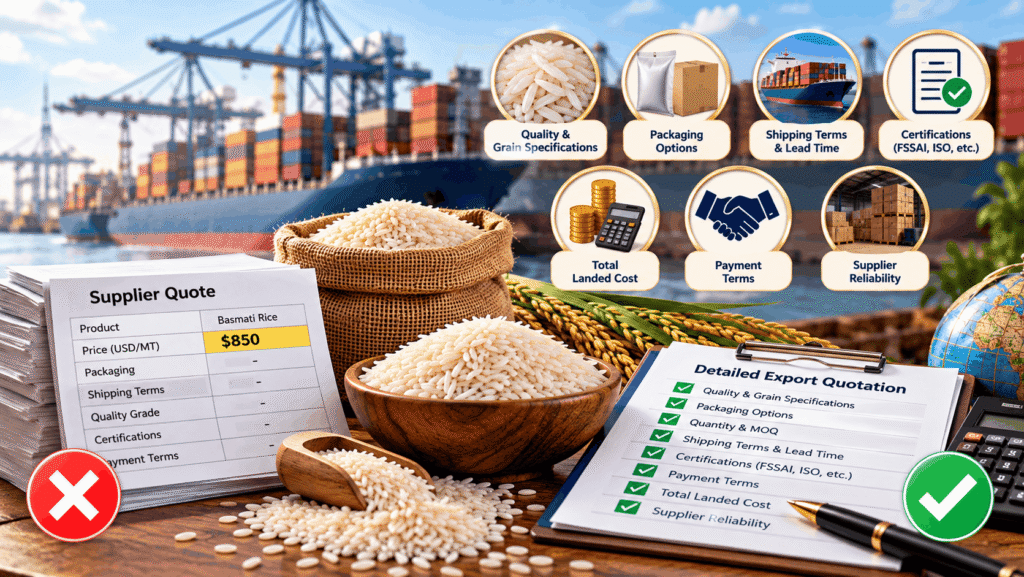
When you compare offers on price alone, you are often comparing unlike goods. A clear specification turns a set of quotes into a fair comparison.
Start with Variety and Grain Specifications
Confirm the Exact Variety
Basmati covers several distinct varieties, including 1121, 1509, 1401, 1718, Pusa, and Traditional Basmati. Each differs in grain length, aroma, cooking behavior, and price. Ask every Basmati rice supplier to name the exact variety. “Basmati” alone is not a specification.
Read the Specification Sheet Line by Line
Request a written spec sheet with each quote. Check these terms:
- Average grain length (AGL): The typical length of raw grains, usually stated in millimeters.
- Broken percentage: The share of broken grains. Lower broken content usually means a higher price and better presentation.
- Moisture: The water content of the rice. Excess moisture can raise storage and spoilage risk in transit.
- Admixture: The presence of other rice varieties mixed in. Ask for the permitted limit.
- Processing type: Raw (white), steam, or sella (parboiled). Golden sella and creamy sella differ in color and cooking behavior.
- Aging: Aged rice typically cooks fluffier and separates better. Confirm the aging period in writing.
- Sortexing: Optical sorting that removes discolored grains and foreign matter.
A quote without these details is incomplete. Treat it that way.
Check What the Price Actually Includes
Incoterms define who pays for freight, insurance, and risk at each stage. They change the real cost of a quote.
- FOB (Free on Board): The price covers goods loaded at the Indian port. You pay ocean freight and insurance.
- CFR (Cost and Freight): The price includes freight to your port. You arrange insurance.
- CIF (Cost, Insurance and Freight): The price includes freight and insurance to your port.
An FOB quote will always look cheaper than a CIF quote. Convert every offer to the same basis before you compare. Also confirm payment terms, validity period, and whether inspection costs are included.
Verify Compliance and Certifications
Export Registration
Indian Basmati exporters register with APEDA (Agricultural and Processed Food Products Export Development Authority), the government body that oversees agricultural exports. Ask your supplier for proof of current registration.
Food Safety Certifications
Request copies of valid food safety certificates, such as ISO 22000 or HACCP-based systems. Check expiry dates. Confirm the certificate covers the facility that will process your order.
Destination Requirements
Import rules vary by market. The EU, UK, GCC countries, and the US each set their own standards for labeling, residues, and documentation. Confirm your supplier has shipped to your market and understands its paperwork.
Ask Direct Questions About Pesticide Residues
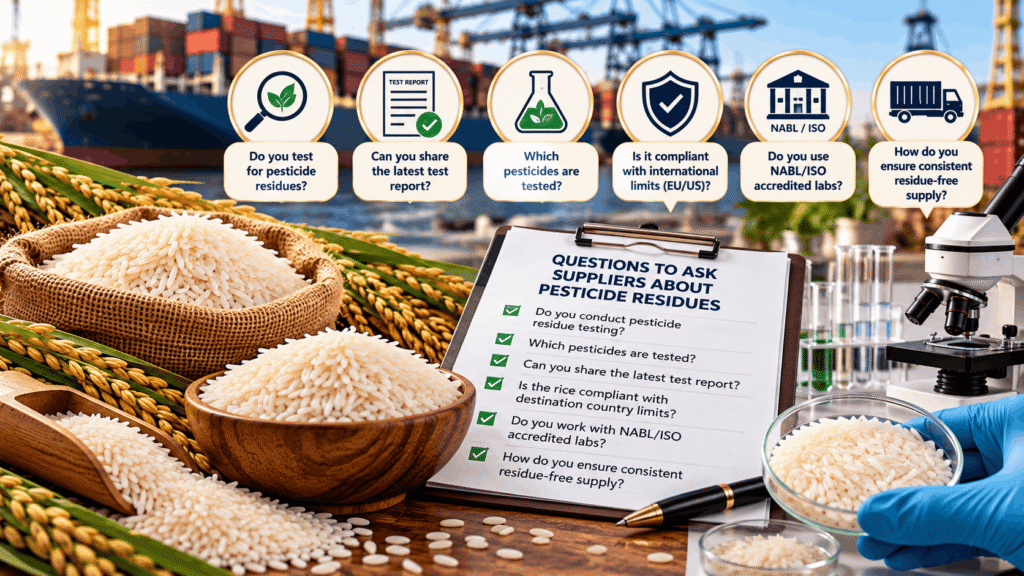
Residue failures can mean rejected containers, destruction costs, and damage to your brand. Many markets set strict maximum residue limits (MRLs), the highest legally allowed level of a pesticide in food. The EU is known for especially tight limits on certain fungicides used in rice.
Ask every supplier three questions:
- Can you provide residue test reports from an accredited laboratory?
- Are tests done per lot or batch?
- Which market’s MRLs does the product meet?
If a supplier markets pesticide-residue-free rice, ask for test evidence for that specific lot. A claim without a lab report is just a claim.
Compare Packaging and Private Labelling Options
Packaging Formats
Packaging protects your rice and shapes how it sells. Common export formats include:
- Jute bags: Breathable and traditional, suited to premium bulk and retail displays.
- BOPP bags: Printed, glossy, and durable. Strong shelf appeal.
- PP bags (transparent or milky): Cost-effective and sturdy for bulk handling.
- Non-woven bags: Reusable feel with good print quality.
- Pouches: Practical for smaller retail packs.
Confirm bag sizes, print quality, inner liners, and palletization in the quote.
Private Labelling Capabilities
For supermarket buyers and private-label brands, packaging is your brand. Ask whether the supplier handles custom printing, artwork support, and market-specific labeling. Clarify minimum order quantities for branded packs.
Assess Bulk Supply Reliability and Track Record
A bulk Basmati rice supplier must deliver the same quality, container after container. Inconsistent lots frustrate customers and erode trust.
Evaluate:
- Years in the rice trade
- Milling and processing infrastructure
- Ability to supply consistent quality across repeat orders
- Experience with your destination market
- Responsiveness on samples, documents, and pre-shipment inspection
Request a pre-shipment sample. Then compare it against the approved sample on arrival.
How GCDN Rice Supports Basmati Buyers
GCDN Rice traces its rice trade roots to 1952, beginning in Naya Bazaar, Delhi. Today, the family-owned business supplies Basmati and Non-Basmati rice to international buyers.
The Basmati range covers 1121, 1509, 1401, 1718, Pusa, and Traditional Basmati. Non-Basmati options include PR 11, Sharbati, Sugandha, IR 64, and Sona Masuri. For residue-sensitive markets, GCDN offers a dedicated pesticide-residue-free range in selected varieties.
Private-label buyers can choose from jute, BOPP, transparent PP, milky PP, non-woven, and pouch formats. Bulk export and private labelling come from one source. One supplier. Fewer handoffs.
Conclusion
A Basmati quotation is only as strong as the details behind it. Compare variety, specifications, Incoterms, compliance, residue testing, packaging, and supply reliability before you compare price. Then the cheapest offer and the best-value offer become easy to tell apart.
Start with a written spec sheet from every supplier. Convert every quote to the same Incoterm. Ask for lab reports.
Sourcing Basmati or Non-Basmati rice for your market? Explore the GCDN Rice product range or contact the export team to discuss your specifications, packaging, and volume requirements.