

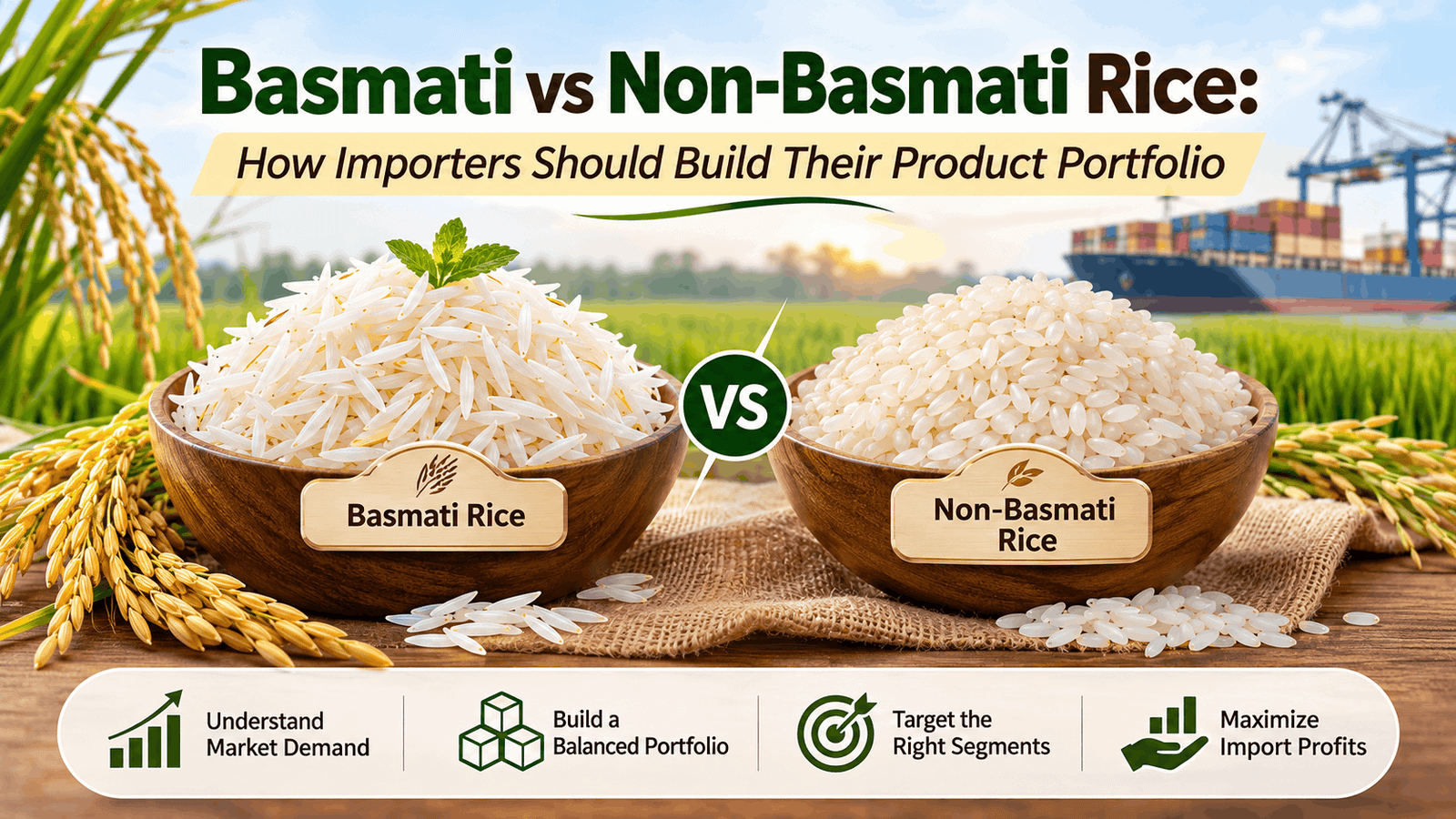
Basmati rice offers long grains, an aroma, and margin profile to capture premium markets, whereas non-basmati rice is higher volume and consistent for the everyday staple. Typically, a well-balanced import portfolio has both basmati and non-basmati rice. The portfolio would have a basmati rice exporter for premium retail and hospitality clients, as well as non-basmati rice for higher volume and lower price segment clients.
International rice importers, food distributors, and private-label rice brands, understand that the differentiation between basmati and non-basmati rice is about catering to different markets based on price and the usages of rice within a given cuisine, rather than picking a winner. Importers can tie up working capital with slow-moving stocks or miss out on margins for premium basmati rice.
This guide breaks down the practical differences between basmati and non-basmati rice, what buyers should weigh when selecting a basmati rice supplier, and how a diversified portfolio can help importers respond to shifting demand across global markets.
What’s the Real Difference Between Basmati and Non-Basmati Rice?
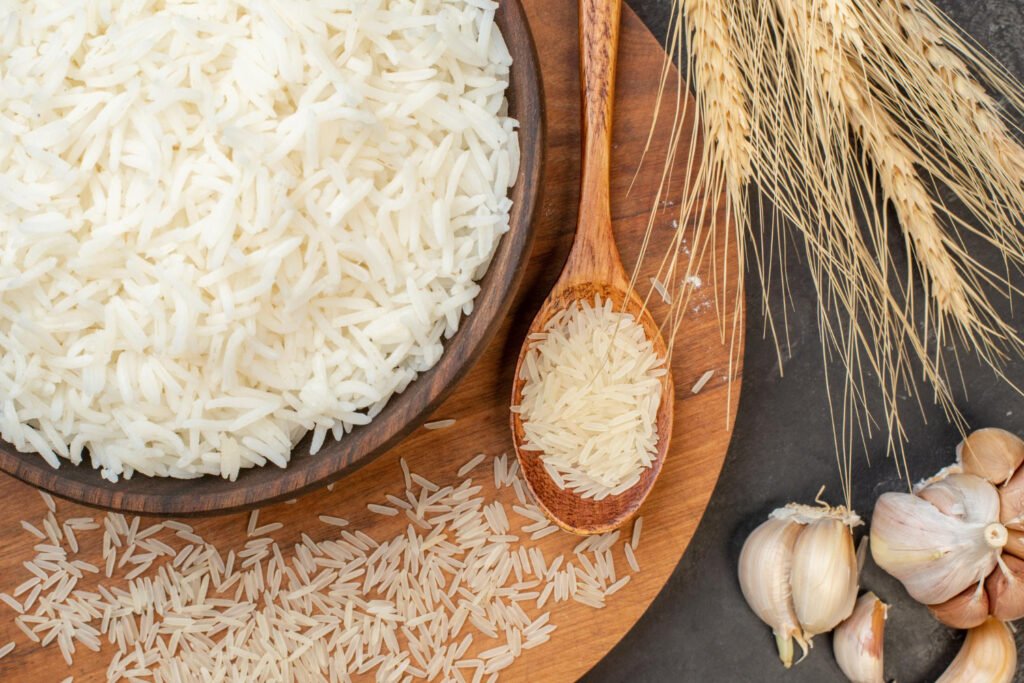
Basmati rice is a fragrant and long-grained rice variety, indigenous to the Indo-Gangetic plains of India and Pakistan. Basmati Rice is defined by the extra-long length of its grain, it’s fragrance, and the way it elongates (as opposed to widening) when cooked. 1121, 1509, 1401, 1718 and Pusa basmati are some of the more popular varieties. Each of these varieties has slight differences in the length of their grains, as well as the strength of their aroma, and the way they behave while cooking.
Non-basmati rice encompasses numerous short, medium, and long grain rice varieties, such as PR 11, Sona Masuri, Sharbati, Sugandha, and IR 64, that are mainly used for daily cooking and bulk food service. Rice varieties that are used for dishes where fragrance and elongation of rice grains are not required.
The main factors that importers consider for differentiation are:
Price: Basmati rice has a longer aging process, making it costlier. Non-Basmati rice is cheaper and is better suited for markets where volume and price are primary considerations.
Culinary Uses: Basmati rice is preferred for rice based dishes where aroma and separation of rice grains are of primary concern such as biryanis and pilafs. Non-basmati varieties are used for day-to-day cooking for rice based dishes where aroma and elongation of rice grains are of no concern.
Positioning: Basmati rice is a premium rice in the market. Non-basmati rice competes on price and availability.
The main concern of buyers, irrespective of rice variety, is the processing and the aging of rice. Aging of rice helps in further reducing moisture content, improves aroma, and gives better elongation of rice grains. Buyers should take into account the aging period of basmati rice, especially if they are sourcing from a premium basmati rice exporting country.
Processing plays a role as well. For example, Sella basmati rice is parboiled and milled together, which makes the grain stronger, reduces breakage during transportation, and adds a slight golden hue to the grain. Sella basmati is a preferred choice for those exporters who wish to cater to the markets in the Middle East and parts of Europe where parboiled rice is predominantly eaten. Traditionally, raw (non-parboiled) basmati is preferred to cater to markets where the traditional white, fragrant grain is preferred.
For non-basmati rice, uniformity of the grain and moisture control is of utmost importance to the food service industry and other bulk buyers. Wholesalers prefer rice to have lower broken grains.
Comparing Basmati and Non-Basmati Rice for Portfolio Planning
It is important for a rice importer to know both the basmati and non-basmati sides of the business to build a stable and profitable portfolio.
Margin Structure: Basmati rice usually commands a higher margin and is therefore well suited for the retail and specialty food business. Non-basmati rice tends to be a bulk item for the institutional and wholesale business and relies more on volume for profitability.
Demand Structure: Non-basmati rice is more often a dietary staple and therefore demand is more stable and more often year round. Demand for basmati rice can be unstable and is more often dependent on the hospitality cycles and seasonal events in the importing countries.
Shelf Positioning: To meet the demands of various segments of the market, retail stores carry both kinds of rice (premium basmati and non-basmati).
Private label opportunity: Both categories have potential for private label basmati and non-basmati rice programs. This allows distributors and retailers to develop their own branded products.
What Should Importers Consider Before Choosing a Rice Supplier?
Importers who focus only on one category of rice restrict their ability to service their customers fully. A grocery chain, for example, may need to source premium basmati for their specialty aisle and non-premium, non-basmati, for their value aisle. Sourcing both from the same exporter simplifies their logistics as well as assures uniformity in quality for the products.
Importers, distributors, and private-label brands considering basmati or non-basmati rice suppliers need to look beyond price per ton to evaluate:
- Certifications and compliance: It is the responsibility of the importer to confirm that the supplier has the required certifications and documents for food safety and quality, and tests for pesticide residue, to comply with the market they are serving.
- Uniformity in shipments: Consistent quality of basmati rice shipments in terms of grain length, aroma, and moisture content is critical for a distributor or retailer to protect their reputation with end customers.
- Packaging: Flexibility in packaging for private label programs is crucial to meet distributors’ and retailers’ branding and presentation needs.
- Export experience and connections: Shipping basmati rice to markets, such as the Middle East and Europe, requires a supplier to have the right documentation, knowledge of port processes and logistics, as well as experience shipping raw versus sella basmati rice.
Reliability of supply chains: Consistent long-term import relationships require consistent lead times and the ability to scale during peak demand periods (festival seasons, business upswings in the hospitality sector, etc.)
The ability to add value to a relationship by understanding rice applications and suggesting the right rice for a dish based on the cooking behavior of the grain is especially beneficial to restaurant and hospitality buyers.
How is global demand for Basmati and non-Basmati rice changing?
The growing preference and recognition of South Asian cuisines in the international market and especially in the United Kingdom and continental Europe has driven up the demand for Basmati rice. Traditionally, the markets of the Gulf (Saudi Arabia, the UAE, Qatar, Kuwait, Bahrain and Oman) are among the largest importers of Indian Basmati rice, with a preference for sella basmati for its better texture and shelf stability.
Even as the demand for basmati rice is growing, the demand for non-basmati rice continues to be high as it is an essential food crop for many nations. There is consistent demand for rice by food distributors and wholesalers for whom the price is the main consideration and not the quality, making it possible for private-label food brands to have a presence in the food market with rice products other than Basmati rice.
Understanding and serving the preferences of different markets is key to a successful sourcing strategy. The private label food brands have the added advantage of risk mitigation as they can easily serve the needs of regions with preferences for non-Basmati rice or parboiled rice.
What GCDN Rice Offers a Diverse Rice Import Portfolio
As a rice exporter based in Delhi, India, GCDN Rice has been in the rice processing and export business since 1952. Their product line includes different types of basmati rice (1121, 1509, 1401, 1718, and Pusa basmati) and non-basmati rice (PR 11, Sharbati, Sugandha, IR 64, and Sona Masuri). Importing companies who wish to diversify their import portfolio can benefit from using the same exporter for both types of rice, as it simplifies the management of quality assurance and control, documentation, and logistics.
GCDN Rice also exports different varieties of basmati rice that are pesticide residue free, and offers private labeling for different kinds of packaging (Non-woven, Jute, Pouch, BOPP, and PP) for rice distributors and retailers, allowing them to enter into the branded rice business without investing in the processing of rice.
Distinction Between Basmati and Non-Basmati Rice in Import Portfolio
In the global food supply chain, basmati and non-basmati rice are often treated as replacements for each other. However, in the strongest import portfolios, basmati rice is often sold in specialty retail and/or hospitality segments and/or in private label formats, and non-basmati rice is sold in high volumes for distribution.
Importers wishing to develop new supplier relationships should focus on consistency, certification, and export experience and not just the price. They should consider if a single Basmati rice exporter can fulfill their requirements for both the premium as well as the bulk segment. Having a reliable supplier relationship for a diversified rice portfolio enables distributors, retailers, and clients in the hospitality industry to meet consumer preference for a wider range of rice varieties without taking undue market risk and overexposing their business to one rice category.