


Reliable Indian rice exporter to the UK offer verifiable quality certifications, clear processing standards, consistent grain specifications, and a well-documented export record. For Basmati rice, buyers should also check on the age of the rice, the testing of pesticide residues, and adherence to the UK food safety regulations prior to signing any supply agreement. GCDN Rice, and other exporters with decades of experience, provide good case studies to show what this verification process looks like.
The UK rice market is as much about trust as it is about tonnage. Supermarkets, wholesalers, and restaurant groups need rice that is consistently supplied, meets specification every time, and clears customs. One failed shipment can cost a distributor its retail contracts. One inconsistent batch can take years to build a good reputation on a supermarket shelf.
This makes taking the time to evaluate the right Indian rice exporter fully warranted. India is the largest producer of Basmati rice and the UK has some of the strictest residue limits of any market, creating a demand that favors experienced exporters. Established supply chains make the most reliable and profitable markets for UK importers, distributors and private label brands.
What Makes an Indian Rice Exporter to the UK Trustworthy?
In the export business, trust is built on data. A good Indian rice exporter to the UK should be able to provide evidence for the following points without hesitation.
Certifications: Exporters should have certifications in international food safety, like the ISO 22000, which set international standards for food safety. Ask to see the certification, not just logos on their website.
Grain Specifications: The length, aroma, moisture and broken grain percentage should be according to the specification. An exporter should be consistent from shipment to shipment.
Pesticide Residue Free: The UK has strict limits on pesticide residue in food and exported rice should meet these limits to be imported. Some exporters state their rice is pesticide residue free which provides an additional assurance for retail and private label rice shipments.
Sourcing and Processing: The exporter should be able to provide detailed information on where the rice was grown and how it was processed (milled, graded and packed).
Experience: An exporter with many years of experience exporting to multiple countries is more trusted because it means they’ve been able to adapt to the ever-changing regulation and demands.
Most exporters claim to export high quality rice. Few can actually give documentation to prove it.
Why Basmati Rice Dominates UK Rice Imports
Basmati rice has a commanding presence in the UK market that other grain varieties do not. Long grains and a particular aroma and texture after cooking make Basmati the preferred rice for British-Asian households as well as curry houses. It has also become a staple in the world food aisles of mainstream supermarkets.
Within Basmati rice itself, UK buyers encounter several named varieties, each suited to different commercial uses:
- 1121 Basmati Rice: Used for retail and hospitality with its extra-long grains and strong aroma.
- 1509 Basmati Rice: A more rapidly maturing variety with a good aroma that is more economical.
- 1401 Basmati Rice: Used for food service, especially with its elongation of grain after cooking.
- 1718 Basmati Rice: A recently introduced hybrid variety with a good balance of yield and quality.
- Traditional Basmati Rice: Aged varieties with a good aroma command a premium.
An Indian rice exporter with the aforementioned varieties allows UK private label companies the flexibility to create rice products specifically suited to different customer segments, as opposed to using a single rice product across all segments.
How to Evaluate a Basmati Rice Exporter to UK: Process, Certifications, and Quality Checks
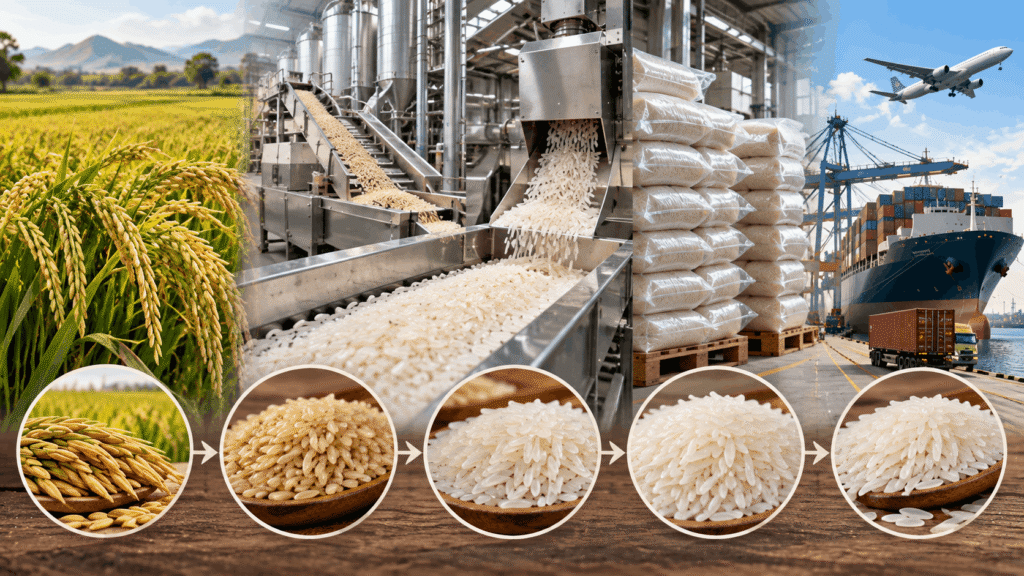
Not every exporter processes rice the same way and the differences show up on your customer’s plates. Here’s what your evaluation process should include:
- Processing Documentation: You need to request processing documentation and check how the exporter has milled, sorted and polished the rice. Modern plants and machinery cut down breakage and contamination.
- Aging Practices: Age Hardening is done by exposing the rice to certain enzymes for a particular period of time, by doing so the rice develops a strong aroma and elongates during cooking. The exporter should mention the duration for which each variety is aged, otherwise the age hardening process is of no value.
- Lab Testing: Lab tests should be done to verify if rice contains any pesticide residue.
- Packaging: Some private label and supermarket brands in the UK require packaging to be done in a particular format. Moreover, some exporters provide private labeling of different packing materials from Jute, BOPP, Non-woven and PP Bags.
- Logistics: Check what lead time the exporter normally has, and how they deal with shipment delays. Usually suppliers with a global presence are able to offer better logistics solutions compared to new exporters.
You need to do your due diligence and evaluate the exporter by including the above mentioned points; or else you are trusting your exporter blindly, which is a risk most of the importers can’t take in this business because the margins are thin and contracts are long.
What Should UK Buyers Consider Before Choosing an Indian Rice Supplier?
Different kinds of buyers think differently and an Indian Basmati rice supplier who is worth doing business with should be able to consider most, if not all, of these priority factors.
- With international food importers, it is consistent, large volumes of Basmati rice exports and reliable shipping schedules that make or break the deal.
- Food distributors and wholesalers are much more price sensitive, while also considering the consistency of the grain across large order volumes.
- Retailers, whether big or small, are increasingly particular about the sourcing and supply of rice to them in line with UK food and retail standards. They expect this of their suppliers as well, along the value chain.
- Restaurants, especially those that pride themselves in offering different, signature dishes, expect their Basmati rice suppliers to have specific varieties of grain.
- Private-label food brands expect their Basmati rice suppliers to meet private-label packaging requirements, without compromising quality.
It would be a good idea to consider an Indian Basmati rice supplier with whom you can partner for the long haul to ensure sustainable practices along the farming and packaging value chain, as more and more customers are demanding this of retailers, including in the UK.

Current Trends Shaping Indian Rice Exports to the UK
UK Buyers who are in tune with the changing trends in the Indian rice export market to the UK are better placed to negotiate harder with their Basmati rice suppliers. These trends include:
- Rising demand for pesticide-residue-free rice. UK consumers and regulators are paying closer attention to residue limits, pushing exporters to expand dedicated pesticide-free product lines.
- Growth in private-label partnerships. Supermarkets increasingly want exporters who can handle end-to-end branding and packaging, not just bulk commodity supply.
- Sustainability as a procurement criterion. Farming practices and packaging materials are becoming part of the buying conversation, not an afterthought.
- Diversification beyond traditional Basmati varieties. Hybrid varieties like 1718 are gaining shelf space as exporters respond to yield and cost pressures without compromising grain quality.
Exporters who adapt to these shifts early tend to retain long-term UK contracts. Those who don’t risk losing ground to competitors who do.
GCDN Rice’s Approach to Exporting Basmati Rice to the UK
GCDN Rice has been a family-owned Indian rice exporter since 1952. That experience has given the firm deep industry connections in the rice trade, and an understanding of what UK buyers expect. In a market where prices determine winners and losers, having that experience can help gain an edge.
GCDN Rice exports Basmati rice varieties including 1121, 1509, 1401, 1718 and others along with non-Basmati rice. The firm also caters to pesticide residue-free varieties. Furthermore, GCDN Rice offers private labelling and various packaging options. These give UK retailers and private label rice brand owners a host of options to get their rice to consumers.
For potential buyers performing due diligence on Basmati rice exports from India to the UK, the combination of heritage, documented infrastructure and flexible packaging, is worth considering.
Making the Right Choice for Long-Term Supply Stability
When a buyer is sourcing Basmati rice from India to the UK, it is not about getting the cheapest price quote. The buyer wants a partner who’s certification, processing standards and track record can withstand the kind of scrutiny their customer will eventually give them.
Run the checklist, request the documentation, ask the hard questions about aging, residue testing and packaging flexibility, before signing any contracts. If the above steps are followed, a steady supply of rice will be sourced to the UK.